
Was My Relative at the Battle of Bennington?
Robert Tegart, Regional History Room Administrator
One of the most common questions we get in the Regional History Room is: “Was my relative in the Battle of Bennington? What was his service record?”
There’s a simple answer to that question; it’s contained in a two-drawer file cabinet labelled “Battle of Bennington Rolls” in the Regional History Room at Bennington Museum. This cabinet contains hundreds of four-by-six cards showing each individual soldier’s name, place of residence, a condensed service record, whether or not he fought in the Battle, and the source of this information.
In addition to the cards, we have documents in our subject file containing details about individuals on both sides of the conflict, including Loyalists from Vermont and elsewhere, and lists of men who fought in the Battle from Bennington and Cambridge, New York. We also have a large box that holds faded manila envelopes from the Depression-era Works Progress Administration in Rutland. These folders contain the names of men who fought in the Revolutionary War but did not participate in the Battle, in alphabetical order with their service records.
But how was this information created? Who performed the research? When was it done?
The short answer is, the US government. One of the WPA’s roles was to create jobs for artists, scholars and others who worked in the arts and humanities. Indeed, when Leroy Williams created “Prisoners taken at Bennington Battle, August 16, 1777,” the mural-size painting that takes pride of place in the Bennington Museum’s Battle of Bennington gallery, that work was funded by the WPA. Similarly, the government initiated projects that would employ historians and other researchers, in an effort to stem the Depression’s blight on the labor force.
The information we have now was compiled through just such a project, done in the early 1940s. It was spearheaded by John Spargo, president of the Bennington Historical Museum (now Bennington Museum).
In his booklet entitled “Souvenir – Illustrated Descriptive Sketch of Bennington Battle Monument with an account of the Bennington Battle,” written in 1947, he states that during the tourist season—every year, and on an almost daily basis—visitors asked for information on their ancestors who may have been in the Battle. He said although there was no published listing, a project to catalog all those who were known to have fought in the Battle had been completed several years earlier.
The correspondence between the Federal Works Agency (the agency that oversaw the WPA) in Rutland and John Spargo, addressing this very project, resides in the Regional History Room. On July 5, 1940, the FWA approved a “project to compile a list of men known to have participated in the Capture of Fort Ticonderoga and Crown Point, 1775, in the Battle of Hubbardton, 1777, and the Battle of Bennington, 1777.” Upon completion, they appointed Spargo to review and evaluate the work. The effort began, and a check for $70 was sent to the FWA Vermont Art Project in Burlington to cover part of the cost.
The project employed nine researchers, who spent three years identifying the listings for publication, and was slated to be distributed to several “important Libraries” throughout the country.
Sadly, the researchers did not complete those last two tasks; their findings were never published or distributed. But before their work ceased, they gathered the information they’d collected, recorded it on file cards, and deposited it with Bennington’s Historical Museum.
This collection is the heart of our Battle of Bennington research, and is the go-to source for inquiries about soldiers who were in the Battle. The supporting documents provide detailed information on Loyalists, as well as listings of soldiers from the area who may have served in the Battle. They also contain granular data on other men who served during the period, though not in the Battle of Bennington itself. The collection is an excellent companion to ancestry records and the many published works on soldiers and sailors who served in the Revolution from Vermont and surrounding states.
Just recently, we unearthed more WPA research that includes documentation on soldiers from surrounding states that served at the Battle, arranged by regiment, containing each man’s service record and payroll listings.
One of the curious aspects of this new material is that it contains a great deal of unused data; folders of worksheets that the WPA researchers possessed, but for some reason didn’t add to the records. These records are for local soldiers, many of whom fought in more contemporary conflicts. We’re reviewing these now, and adding their information to the existing catalog of participants.
Recently even more documents have come to light. We found a large box in the collection, full of faded manila envelopes from the Depression-era Federal Works Agency (part of the Works Progress Administration) in Rutland, each containing the service records of soldiers who may have participated in the Battle. In the archives, we found another box, this one holding copies of payroll listings, arranged by regiment, for soldiers from surrounding states that served at the battle.
And yet, just as we gained momentum on this formidable task, another surprise awaited us. It soon became evident that somewhere along the line the WPA researchers had never finished their work. Information on veterans whose last names began with the letter M were all accounted for, details diligently gathered and recorded; after that, nothing. Soldiers whose names began with N through to Z were absent, their data never carried over to the card files. Looking at this gap, our course was clear; we needed to complete the mission, and add this information to the existing card catalog.
We set about creating a set of procedures and enlisted the aid of seven volunteers who relentlessly transcribed these new names and service histories onto a Google spreadsheet. This information was reviewed and edited and then copied to a master spreadsheet. Thanks to the dedication of these undaunted volunteers, we now have a list of over 1,500 additional soldiers who were either involved in the Battle or in the area at that time. We’re proud to say that we’ve completed the project that was started over 85 years ago.
This gives us a searchable document to study the men who participated in the battle along with their units, and where they were mustered in. It also gives us many first-hand accounts of their participation in the battle.
But it’s not over. The next step will be to verify the information on these soldiers and add it to the card file with the earlier data. Then we’ll study the results. Finally, we can without a doubt answer the question “Did my great great grandparent participate in the Battle of Bennington?” Thanks to the volunteers who did an enormous amount of transcription, the volunteer staff of the Regional History Room, and the museum’s collections manager!
If you would like to pitch in and help with this crucial effort, contact Robert Tegart or Dave Pilachowski at the Regional History Room at Bennington Museum. They can be reached at library@benningtonmuseum.org

These envelopes held worksheets that scholars, working for the WPA in the early 1940s, used to compile service records for Battle of Bennington veterans. As indicated on the front of this one, not all materials were deemed reliable enough to use.

WPA researchers pored over muster rolls, veteran’s pension applications, and reams of other primary sources, then condensed their findings onto four-by-six-inch index cards like these. The cards have resided in Bennington Museum’s collection for almost 80 years.
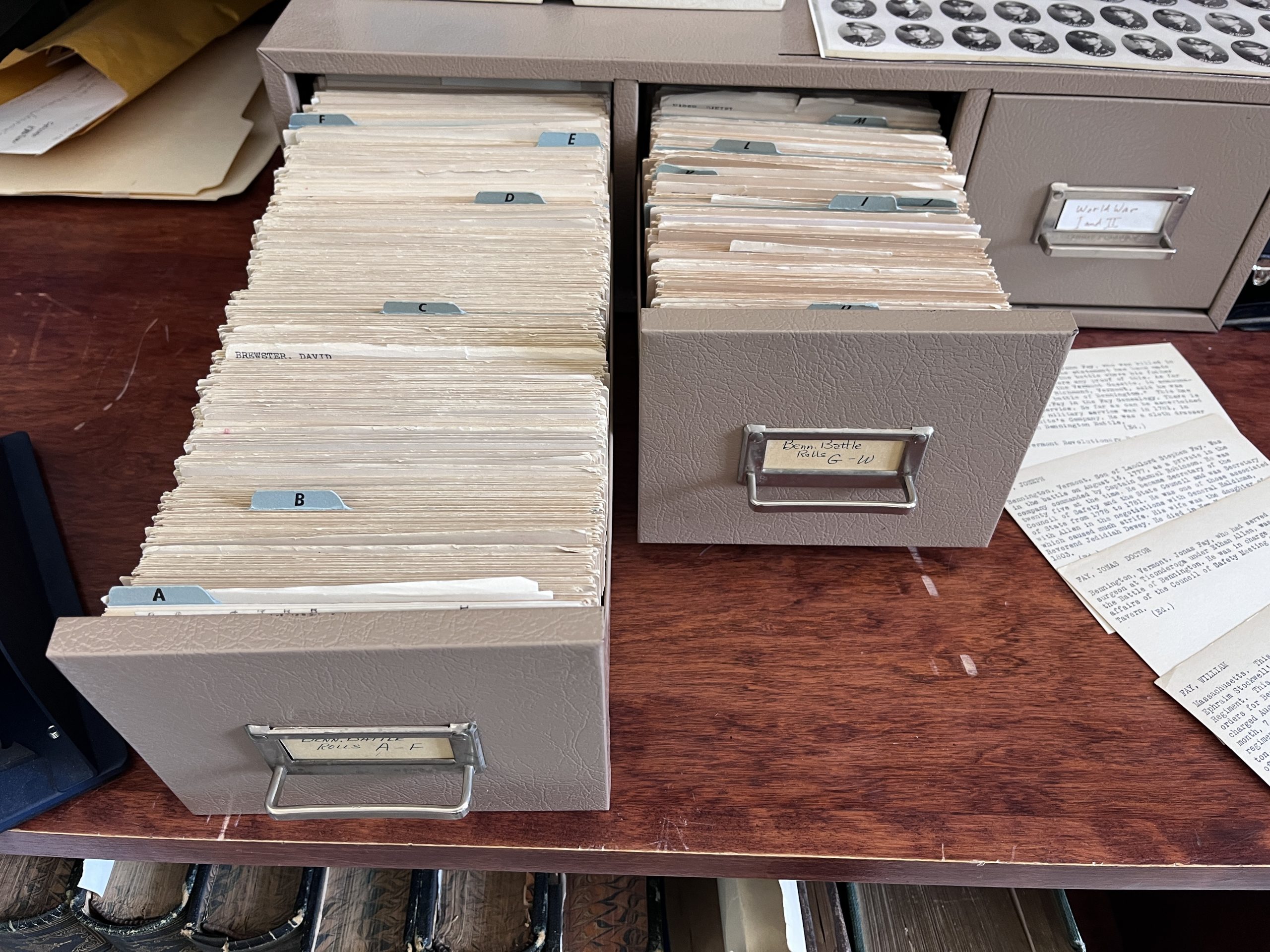
The completed index cards were neatly stored in the file drawers pictured here. The RHR’s David Pilachowski estimates that in all, the collection numbers about 3,000 cards, each evaluating the attribution of military service of a soldier who may have served at the Battle of Bennington.