

Left to Their Own Devices
October 10 @ 7:00 pm - 9:00 pm

NOTE: Doors open AT 7:00 for this event. Arrive any time between 7 and 8 to enjoy the full experience.
Part performance, part interactive sound experience, “Left to Their Own Devices” features a series of interactive musical mechanisms that invite and respond to audience interaction. Wander the Museum at your own pace, in your own path, and engage with the devices and performers.
The Devices
Tintinnalogia is a mechanical carillon fanned out around the new courtyard. The 8-bell device is inspired by the British tradition of change ringing, in which permutations of bells are rung out in a frenzy. Every 15 minutes a piece is performed like clockwork.
Extant is an immersive installation about celestial navigation amidst rising tides; it uses the sextant the artist’s grandfather used to sail to Tahiti. The sextant, a navigation tool, is based on imprecise science, relying on where you thought you once were to predict your current position. As the audience uses the device, a sound collage gradually loses itself, as it tries to locate the viewer’s place.
Heterodyne is inspired by the inventor Leon Theremin’s dance platform called the Terpsitone, and his 1936 visit to Bennington to demonstrate the device. Heterodyne translates movement into sound, tracking one person’s motion and mapping it onto a projected doppelganger, using technology akin to the theremin, the contactless instrument named for its inventor.
Comb is a work inspired by the silent instruments in the Museum’s Church Gallery. As the audience wanders the room, lasers and sonar devices create a collage based on what the devices might have sounded like back then, based on the shape-note hymn Evening Shade.
In Hypnagogia electric muscle stimulants create involuntary movements in three dancers, conveyed through wireless belts. These tics are generated by the sound itself and are part of an improvisation between the intentional and the unexpected. Hypnagogia is a transitional state between sleep and wakefulness, in which people experience hallucinations and uncontrolled tics.
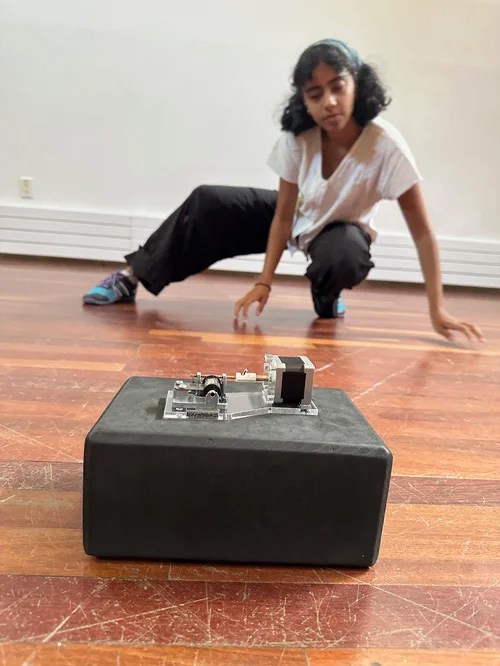
In Barrel Roll a tiny device constructed out of a music box and a yoga block perceives movement. Playing with the trope of a music box twirling a porcelain ballerina, each participant turns the barrel and creates a kaleidoscopic collage out of each tune.
Nicholas Brooke creates music across disciplines, from collages of recordings with live theater, to home-built instrumentariums inspired by gamelan. Brooke’s works have been featured across the U.S. and Europe, at Mass MoCA, HERE, Merkin Hall, Baryshnikov Arts Center, the MATA Series, and the Spoleto Festival, and have been performed by the Bang-on-a-Can All-Stars, Talujon, Speculum Musicae, Orchestra 2001, the Paul Dresher Ensemble, the Nash Ensemble of London, and Sekar Anu. He has received Guggenheim and Rockefeller Foundation awards, and multiple residencies including Djerassi, MacDowell, Bogliasco, and Bellagio. Originally a clarinettist, he is also an avid instrument builder, and researcher of early musical automata. During a two-year fellowship to Central Java, he studied gamelan and collaborated on musical projects with Javanese composers, dancers, and visual artists. He holds degrees in music composition and philosophy from Oberlin, and a Ph.D from Princeton. He teaches at Bennington College.
Music at the Museum programs are presented at no charge, thanks to our generous sponsors,
Alison Nowak and Robert Cane