
Back to school, back to history: Bennington Museum opens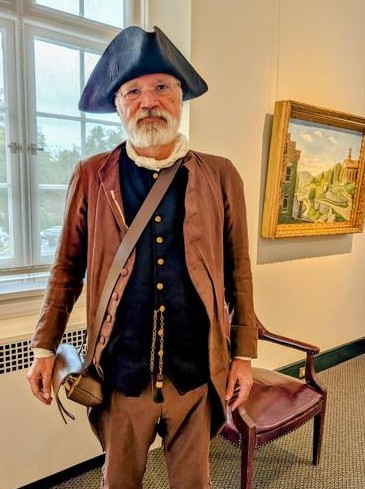 its doors to families, students, and teachers
https://www.benningtonbanner.com/local-news/back-to-school-back-to-history-bennington-museum-opens-its-doors-to-families-students-and/article_9b06a5b8-37f9-45b9-9eae-013aa904c2be.html
BENNINGTON — Bennington Museum’s third annual Back-to-School Community Day might look, at first glance, like a family-friendly open house – kids were weaving through galleries with scavenger hunt cards, volunteers were guiding hands-on activities in the various galleries, a “Fiber Arts Army” had set up an encampment upstairs and were engaging youngsters in various skills, and live music by guitarist and vocalist Katie Beck drifted through the halls.
But, beneath the free admission and festive atmosphere lay something more ambitious – the museum is steadily positioning itself as a year-round educational resource for local families, as well as for schools, teachers, and students.
“Part of what we try and do is help impart a sense of pride in the people who live here about this place,” said Assistant Director of Engagement and Editorial Projects Damien McCaffery. Surrounded by cases of tools, toys, instruments, and portraits in the Church Gallery, he gestured toward the dense displays of everyday objects. “It is such an amazing well of innovation. People really do for themselves as they need. They make do. They figure it out. And, we’ve got a lot of evidence of that. This museum just contains a lot of the fruits of that ingenuity.”
A free gateway for families and educators
The Back-to-School Community Day, sponsored by Stewart’s Shops and the Vermont Country Store, offered free admission on Sunday – key piece of lowering barriers for new visitors. According to Director of Public Programs Deana Mallory, the museum used the day to welcome both families and teachers without the hurdle of ticket prices.
“This is our third year, I believe, of doing a back-to-school community day, celebrating the return to school for all of our kiddos and our educators,” Mallory explained. “It gives us an opportunity to welcome in the whole community without having to worry about the barrier of admission fee. It’s a great opportunity for people who haven’t been here before – to come try it out and discover that it’s awesome and that they want to come back over and over again.”
Teachers are a central audience for the event. Museum educators are on hand to talk about initiating school programs, both on-site and in the classroom. The museum – of course – welcomes field trips, but they also have staff who can “go out to the schools as well, bring[ing] our materials into the classroom and present[ing] there,” Mallory said. As an added incentive, teachers who visited the Museum on Back-to-School Day received a 20 percent discount in the museum store and a chance to win a family membership.
Learning by touching, searching, and making
Across the lower and upper galleries, volunteers and staff worked to turn static displays into active learning experiences. In the pottery gallery, for example, youngsters studied historic shapes and decorative details before sketching their own designs. In the Church Gallery, Volunteer Gail led what was essentially a focused, room-sized, scavenger hunt for oddities and curios that suddenly became interactive.
“Kids are trying to find things on the cards,” Volunteer Gail explained, indicating the prompts on various cards that presented questions for a deeper dive. “And, it just gets the kids involved.”
One example of this became evident as youngsters explored the portrait of Hugh and Wright Carpenter and the marble sculpture “Sleeping Children.” These became points of entry into Victorian ideas about death, innocence, and memory. The interpretive text explained that the portrait was painted after the boys died of dysentery at about two years of age, and that such posthumous portraits were a way of ensuring young children “were not soon forgotten.” Additionally, traditional ideas of gender and dress were highlighted as both young boys were depicted in white dresses with a stunning lace detail.
Located just beneath the painting, William H. Reinhardt’s marble group “Sleeping Children” parallelled a similar theme, offering another “mode of commemorating the death of children.”
McCaffery often uses these works to challenge the assumptions of youngsters and deepen their sense of historical context. Describing how he introduces the portrait to younger groups, he said, “Every single kid wraps up, and I take them over to see those kids, the [Carpenter] boys. They’re dressed in those white gowns, so they look like girls, but they’re actually both boys. And, the fact that they died so young – only three and a half months apart.”
McCaffery’s goal is not to sensationalize the past, but to help youngsters see how people once coped with grief and mortality, how art and objects can hold those stories, and how – as we relate to loss and grief today – we are truly not so different from those who came before us.
Everyday objects, extraordinary lessons
For McCaffery, the Church Gallery is a kind of historical laboratory.
“What I love about that gallery is everything in it, except for the paintings, was either touched by human hands or had an actual utilitarian value to people,” he said. The room holds surgical instruments, toys like the “brownies” (“the Pokémon of the Victorian era,” as he called them), dollhouses, jewelry made of human hair, early dental molds and tools, and even an early X-ray device.
“A lot of kids don’t know, for instance, that there was no such thing as a dentist before pretty early in the 20th century,” McCaffery noted. “So you would go to – strangely – a barber or a blacksmith to get dental work done, if you were lucky enough to get any dental work done at all.”
By placing odd, sometimes unsettling objects in front of students, staff invite questions about health, labor, technology, and social norms. The gallery becomes a launchpad for discussions. How did people treat illness? What did they value? What did childhood look like? And, the answers are embedded in the artifacts themselves.
A campus for teachers – field trips, the teaching institute, and student shows
While the day’s activities on Sunday focussed largely on families, it was clear that the Museum’s educational strategy extends far beyond a single event.
Executive Director Martin W. Mahoney emphasized that the institution wants to be a dependable partner for schools, “We definitely always want the Museum to be a resource for teachers,” he said. “It is a trove of cultural information about the region.”
Mahoney pointed to the annual student art show, which brings local students’ work into the museum’s galleries in the early spring – literally putting children’s art on the walls.
Mallory also runs a teachers’ institute, described as a week-long session that offers “guidelines and techniques in using the museum as an educational resource.”
Those efforts dovetail with the Museum’s physical changes.
The ongoing renovation of the historic Moses classroom – a space stripped “down to the studs,” re-insulated, rewired, and soon to include a new bathroom – is transforming it into a dedicated makerspace for children and the community.
Once it opens, planned for November, the classroom will provide a flexible workshop-style environment for art-making and hands-on learning.
Hidden resource, shared responsibility
Upstairs and around a nondescript corner, away from the bustle of the galleries, volunteer librarian and researcher Bob Tegart quietly tended what several people independently called a “hidden resource” – the Regional History Room.
Filled with town histories, atlases, genealogies, diaries and self-published books, maps, WPA-era research on veterans of the Battle of Bennington, and a card catalog that allowed descendants to trace ancestors who fought in the battle – the room broadens the Museum’s educational mission beyond school-age children.
“We’ve got a lot of historic information on the state, on the counties, on the towns,” Tegart said. “Every town around we’ve got a book, and they’ve got a lot of genealogical information.”
Teachers who bring classes into this space can show students 18th- and 19th-century maps of their own towns, trace family names and lineages, and see how communities changed over time. Insurance maps document building footprints and uses, and family histories preserve the stories that never made it into textbooks. For older students, the room offers a path into primary-source research and local historiography.
MCCaffery sees all of this – galleries, classroom, and archives – as interlocking parts of a single educational vision.
“What Deana [Mallory] and I try to do is to bring that stuff to life,” McCaffery said of their work with school groups, adding that youngsters will understand the relevance once the conversation begins. “These are things that teachers could bring their classes to see, and they will be engaged in it.”
On Back-to-School Community Day, that relevance is on full display – children hunting for details in marble and paint and artifacts; teachers gathering ideas for future field trips; folks of all ages exploring, sewing, creating, and crocheting; and a museum quietly making the case that history, art, and material culture are not just to be observed, but to be used – daily – as living tools for learning.
Practical access for local schools
For educators interested in tapping into the resources offered by the Bennington Museum, the process is straightforward. Teachers can call the Museum’s front desk and ask for Deana Mallory to arrange a field trip or outreach program. From there, staff help shape visits that match grade levels and curricular goals – whether that means focusing on Victorian mourning practices, early industry and innovation, regional mapping, or student art-making in the new Moses classroom.
As the museum’s infrastructure improvements and educational offerings grow, the Back-to-School Community Day serves as both celebration and invitation – an open door into a hidden resource, waiting to be claimed by the region’s families and classrooms.