
Posted by Mark Rondeau of the Bennington Banner on December 8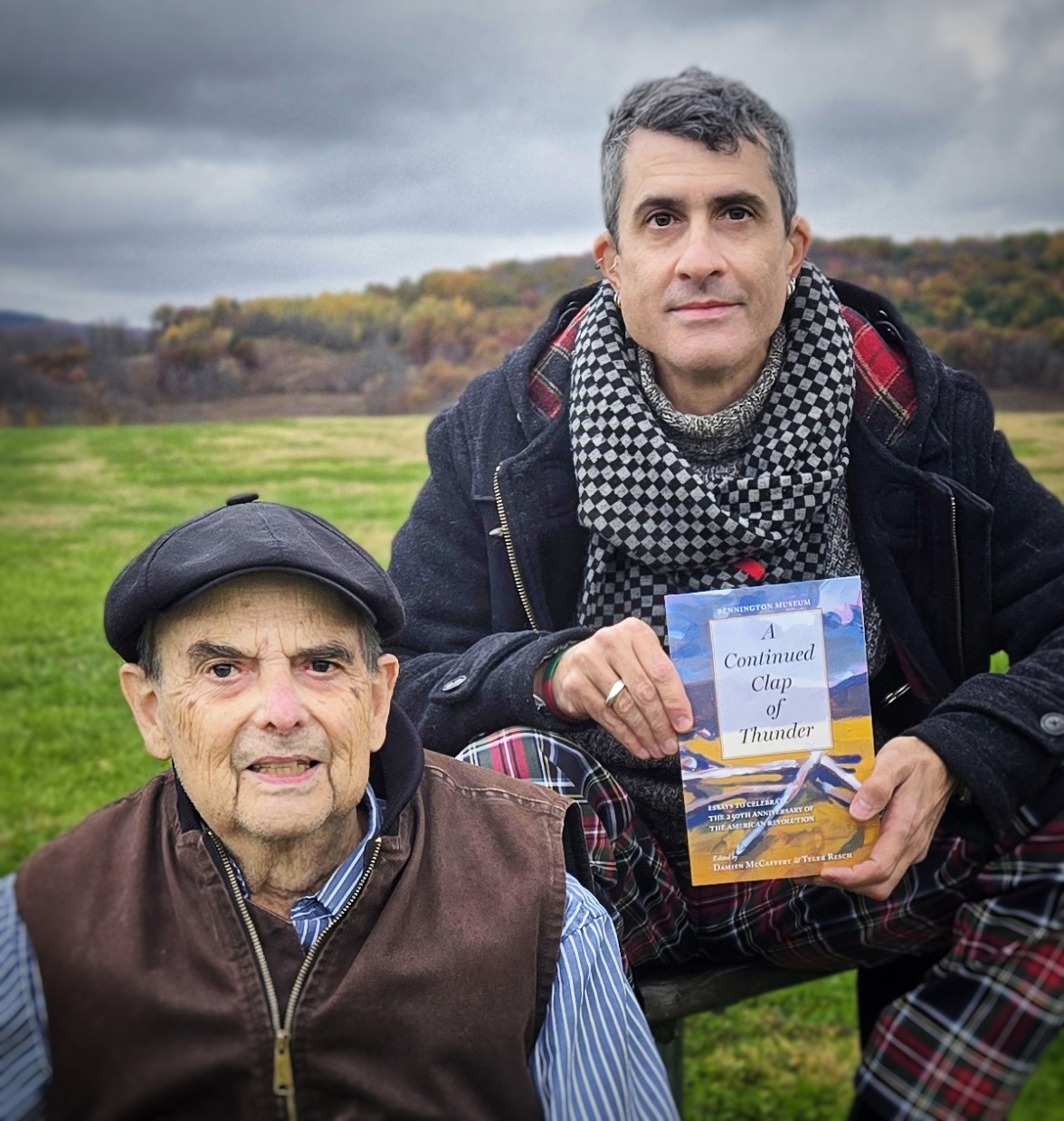
benningtonbanner.com/local-news/book-review-applause-for-a-continued-clap-of-thunder/article_9bf5b4b3-eb06-4abc-8161-5673a6ef0f4c.html
When I interviewed the editors in August, I knew I wanted to read “A Continued Clap of Thunder,” published this fall by the Bennington Museum.
The title comes from American Gen. John Stark’s description of the Battle of Bennington, claiming it was “the hottest engagement I have ever witnessed, resembling a continual clap of thunder.”
The book consists of essays to celebrate the 250th anniversary of the American Revolution. Several of the essays are reprints from The Walloomsack Review, a magazine of local history that the Museum published between 2008 and 2020.
It is edited by Damien McCaffery and Tyler Resch. McCaffery is assistant director of engagement and editorial projects at the Bennington Museum. Resch is a local historian, author and a former editor of the Walloomsack Review.
Featuring meticulously researched and well-written contributions, this volume is worthy of the event it commemorates.
The first section, “Echoes of the American Revolution,” deals with the Battle of Bennington. Reading these gave me a clear idea of what happened, and it motivated me to make my first-ever visit to the battlefield one recent afternoon.
Two essays by Michael A. Bellesiles and one by T.H. Breen focus on the stylish and mercurial incompetence of Gen. John Burgoyne. As Resch writes in his introduction to the volume, the general provoked the Battle of Bennington “as part of a grand and illusory scheme to split the New England provinces from the rest of the continent.”
The British high command looks no more competent in Bellesiles’ essay “Losing an Empire with Class: The Trial of General John Burgoyne.” There seemed to be no effort on high to synchronize the campaigns of the various generals fighting in the colonies.
“The King, his government, and most of their officers were also highly confident largely because of a low estimation of the Americans, a high opinion of themselves, and a conviction that most common Americans would realize the first two as facts,” Bellesiles writes.
Ennis Duling, in “The Life and Unsettled Reputation of Seth Warner,” sorts through a varied literature over the years produced about this Green Mountain Boy. Warner was pivotal in both the conflict over land grants with New York and the fight for independence against the British. “Eventually, there were two Seth Warners, a hero and a little-known man standing in the shadow of Ethan Allen.”
“Warner’s biography is so malleable because at important moments there are few original sources,” Duling writes. “If he saved his letters – his son Israel claimed his father sealed them in a barrel and gave them to a friend – they did not survive.”
After the war, Col. Warner returned to his hometown, Woodbury, Connecticut, very ill and deeply in debt, where he died at 41 on Dec. 26, 1784. Duling favors the view that Warner was indeed a hero.
At the end of his 40-page essay, he tells of Bennington industrialist and philanthropist Olin Scott’s determination to place a monument to Seth Warner on the site of the Bennington Monument. The 26-foot-high tribute, erected in 1910, stands at the head of Monument Avenue to this day.
Duling cites numerous problematic elements with this statue. It’s not Warner’s likeness, for no portrait of him was painted. Some have noted the statue’s similarities to one of Ethan Allen in the National Statuary Hall and the Revolutionary Soldier on Main Street in Manchester.
There are problems with the inscriptions on the base, too; for instance, the dates of the confrontations with New York officials on Breakenridge farm are mixed up.
“And doesn’t the prominence of the statue mislead visitors into thinking Warner was in overall command at Bennington, not John Stark, whose life-sized bronze statue was placed north of the towering Battle Monument?” Duling asks. “None of that matters. Weathered by rain now, Warner stands where he ought to be, still steadfastly protecting Vermont and the young nation.”
Two poignant essays look at the German soldiers who fought in the Battle of Bennington. These clear up misconceptions and humanize these soldiers. In his essay “Who Were Sixteen ‘Hessians’ Killed at Bennington?” Lion G. Miles notes that most of the soldiers who fought at Bennington were not from the area of Germany known as Hessen but “from the Duchy of Braunschweig and should be called Braunschweigers or Brunswickers.”
Charles L. Byler tells the story of Johann Michael Kasler, a ‘Hessian’ (Brunswicker) soldier at the Battle of Bennington. After the battle, Kasler lay wounded by a gunshot on the field, his head raised up against a tree. A passing American maliciously shot him again.
Still alive, Kasler had put his head up against the tree again when another American soldier came along: Peter Howe, of New Marlborough, Massachusetts. This soldier had mercy on the wounded man, gave him water and brought him into town to be treated for his wounds by a German doctor.
Kasler survived, stayed in the United States after the war and married a woman from West Stockbridge, Massachusetts. They settled in New York. Several generations later, a direct descendant of Johann Michael Kasler, Col. James H. Kasler, served in World War II, Korea, and Vietnam, becoming “one of the most highly decorated military men of all time and in all wars.”
Yet, this essay – “Johann Michael Kasler: Heritage of Hessian Soldier” – contains an even more remarkable revelation, one I won’t give away. It occurred near the end of the long life of Peter Howe, the man who saved Kasler.
During my aforementioned visit to the Bennington Battlefield, I noticed a plaque affixed to the carriage of one of the canons on site. It is from the Kasler family, presenting the artillery piece to the State of New York in memory of their ancestor, Johann Michael Kasler.
Vermontiana
The second part of the book, “Vermontiana: Chapters from Vermont History,” contains 12 essays telling stories from its subsequent history.
John J. Duffy’s essay, “Flirting with Treason: The Allen Brothers’ Adventures in Real Estate,” shows in detail the questionable machinations of Ethan, Ira and Levi in talking business and politics with the British near the end of the Revolutionary War and afterward.
Some of the essays tell the stories of historic events and enduring institutions, often through a focus on one individual.
Vermont was not one of the original 13 colonies and was not admitted to statehood until 1791. Robert A. Mello writes about “Moses Robinson: Architect of Vermont Statehood.” Moses was son of Samuel Robinson, founder of Bennington. The ratifying convention was held at the Bennington Meetinghouse to “take into consideration the Constitution of the United States and see whether they will accede to the same.”
Anthony Marro writes about “Perry Merrill, Vermont’s Forester Extraordinaire,” who at the time of his retirement the Rutland Herald described “as a patron saint and guiding light of the multimillion-dollar Vermont ski industry, the man who preached its economic potential and used his power to nurture it when other Vermonters thought skiing, at least the downhill kind, was for showoffs, sissies and flatlanders.”
In “The Uneasy Hospital Era of Miss Mary Baker: From Roaring Twenties to Great Depression,” Resch explores the history of Putnam Memorial Hospital (now Southwest Vermont Medical Center). Baker was the hospital’s first supervisor.
“Miss Baker became a towering presence in the Bennington community. As the dignified and dominant figure of the first twenty-five years of the hospital, she was continually plagued with a policy dilemma – a public relations quagmire – about how to handle ‘charity cases,’” Resch writes. “The problem of providing for indigent patients remained unresolved, and in fact it outlived her by many years.”
The essays in the second part of the book, in particular, explore recurring issues, questions and dilemmas in the history of the state.
Two essays deal with education. “Brightly Shines the Female Mind” by Ruth Burt Ekstrom examines educational opportunities for girls and young women in the early days of Bennington. Phil Holland writes of “Robert Frost and His New Neighbor – Bennington College.”
“‘The Mountain Rule’: Railroad Barons, Temperance, and the 1902 Governor’s Race” by Anthony Marro deals with, among other things, the influence of money in politics and the question of who qualifies as a “real” Vermonter.
The question of local versus outside control played a part in the debate over Vermont joining the United States and can be seen in other essays in the book. Questions of control, as well as the recurring issue of development versus conservation, feature prominently in “Green Mountain Boys Redux: Deane Davis, Land Development, and the Origins of Act 250” by Paul M. Searls, a professor of history at Vermont State University.
One thorny issue that has faced Vermont throughout its history is its struggle to maintain its population. Earlier this year, the Vermont Futures Project said the state needs to add about 13,500 workers each year over the next 10 years to keep up with demand and grow its economy.
In “How Vermonters Prospered During the Gold Rush,” Eileen Scully writes about a major out-migration in the middle of the 1800s.
“Across Vermont, the Gold Rush felt to many like a mass evacuation, the acceleration of an outmigration that was already diminishing the state’s delegation in the U.S. House of Representatives from four to three Congressional districts,” Scully writes. “Indeed, the 1850 census confirmed what many feared: ‘the sons and daughters of Vermont residing in Vermont numbered less than 228,941, and the children of Vermont residing in other states mainly at the west numbered nearly 146,000. In other words, about 39 percent of Vermont’s native-born population had emigrated from it elsewhere.’”
Indirectly, one gets the same impression of out-migration from “Sixty-Four Civil War Generals Were Born in Vermont” by Patrick E. Purcell. They may have been born in Vermont but most did not live in the state after their military service.
This piece, more compilation of brief biographies than an essay, had me constantly going to my phone to look up more about these soldiers, including what they looked like. These generals range from the distinguished to the undistinguished.
For instance, there’s Lewis Addison Grant, known as “the Other General Grant,” born in Winhall in 1828. He commanded the 1st Vermont Brigade at Fredericksburg and Salem Church, for which he was awarded the Congressional Medal of Honor.
Then there was Edward Henry Stoughton, of Chester, the son of the U.S. Attorney for Vermont and a West Point Graduate. While in command of the 2nd Vermont Brigade he had his headquarters in an isolated area about four miles away from the rest of his outfit.
“On March 8, 1863, Colonel John Mosby, the Confederacy’s ‘Gray Ghost’ captured Stoughton along with 30 other soldiers and 58 horses. President Lincoln was not pleased: “I can make a better brigadier in five minutes. Why, sir, these horses cost us $125 a head.”