
Thanks to a loan from Art Bridges, Bennington Museum will be the recipient of four pieces to display in our galleries this spring through 2027.

Paul Cadmus, Lloyd and Barbara Wescott
George Henry Durrie, To Hartford – IX Miles
Horace Pippin, Holy Mountain I
David Smith, March Sentinel
The first three works (Cadmus, Durrie, and Pippin) will be installed in the Moses Gallery in April because, in 2025, we will be loaning several Moses pieces to a major retrospective at the Smithsonian American Art Museum. The loan of these works from Art Bridges will provide us with opportunities to explore new contexts for Moses’ work during this time, and share the work of three important American artists that our visitors are otherwise unlikely to see in person.
Moses was familiar with Durrie’s work through its reproduction via Currier & Ives lithographs. Their images have long been used to construct a nostalgic image of New England in the popular imagination. Cadmus’ painting of a farming couple with livestock and barns in the background echoes Moses’ own frequent depictions of agricultural work and allows us to explore the role that Regionalism/American Scene painting played in the reception of Moses’ work. Summer 2025 to Fall 2025, we will be featuring an exhibition, Green Mountain Magic: Uncanny Realism in Vermont, which will explore Magic Realism in Vermont, including the work of Cadmus and others in his circle, providing yet another lens through which our visitors can experience this work. Pippin’s artistic trajectory reflects that of Grandma Moses in that he was a rural self-taught painter, and a minority, reflecting a more welcoming and inclusive definition of who can be an artist. Pippin and Moses came to fame in the late 1930s, as the mainstream art world embraced the work of self-taught artists. Many of these artists, like Pippin and Moses, a Black disabled veteran and an aging farm wife, helped to expand diversity in the American artistic canon, a topic still of great interest to us today.
In late May, David Smith’s large sculpture will be installed in the Bennington Modernism Gallery, where we show the work of artists associated with Bennington College. Smith lectured and exhibited at Bennington College and was a regular participant in the local art scene. This will be the first time we’ve been able to share a major Smith work as part of the larger story of Bennington Modernism.
In February and March, a group of museum new-comers joined an 8 week workshop geared to helping them discover the many different ways to look at and appreciate art. We filmed short documentaries of their journeys, describing their experiences learning to enjoy, and talk about many of the pieces in the Museum. Generous support for this project has been provided by Art Bridges.
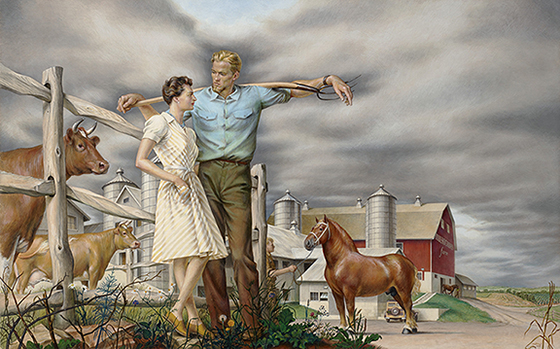
Paul Cadmus (1904-1999)
Lloyd and Barbara Wescott, 1942
Tempera on gessoed board
21 3/4 x 35 in.
Art Bridges
A swelling gray sky looms above an idyllic farm scene in Paul Cadmus’s Lloyd and Barbara Wescott. The artist’s delicate details, seen in the flora and fauna, farm buildings and surrounding landscape, blends themes of American Regionalism and Magical Realism. Cadmus’s subjects seem unbothered by the emerging tension between land and sky. Instead, the central figures casually pose next to their real-life award-winning livestock, flanked by the boundaries of a wooden fence and a pitchfork.
Lloyd and Barbara Westcott, the couple depicted in a moment of repose, were friends of Cadmus and often hosted artists on their farmland. Many works by Cadmus were more outwardly concerned with gritty social commentary and erotic depictions of the male form but Lloyd and Barbara Westcott quietly embeds similar themes.
In its whimsical details, the erect masculinity of the stallion counters a dairy heifer at pasture. The artist’s experience as a master draftsmen, who closely studied classical figurative compositions and painting techniques, is reflected in the precision of the work.
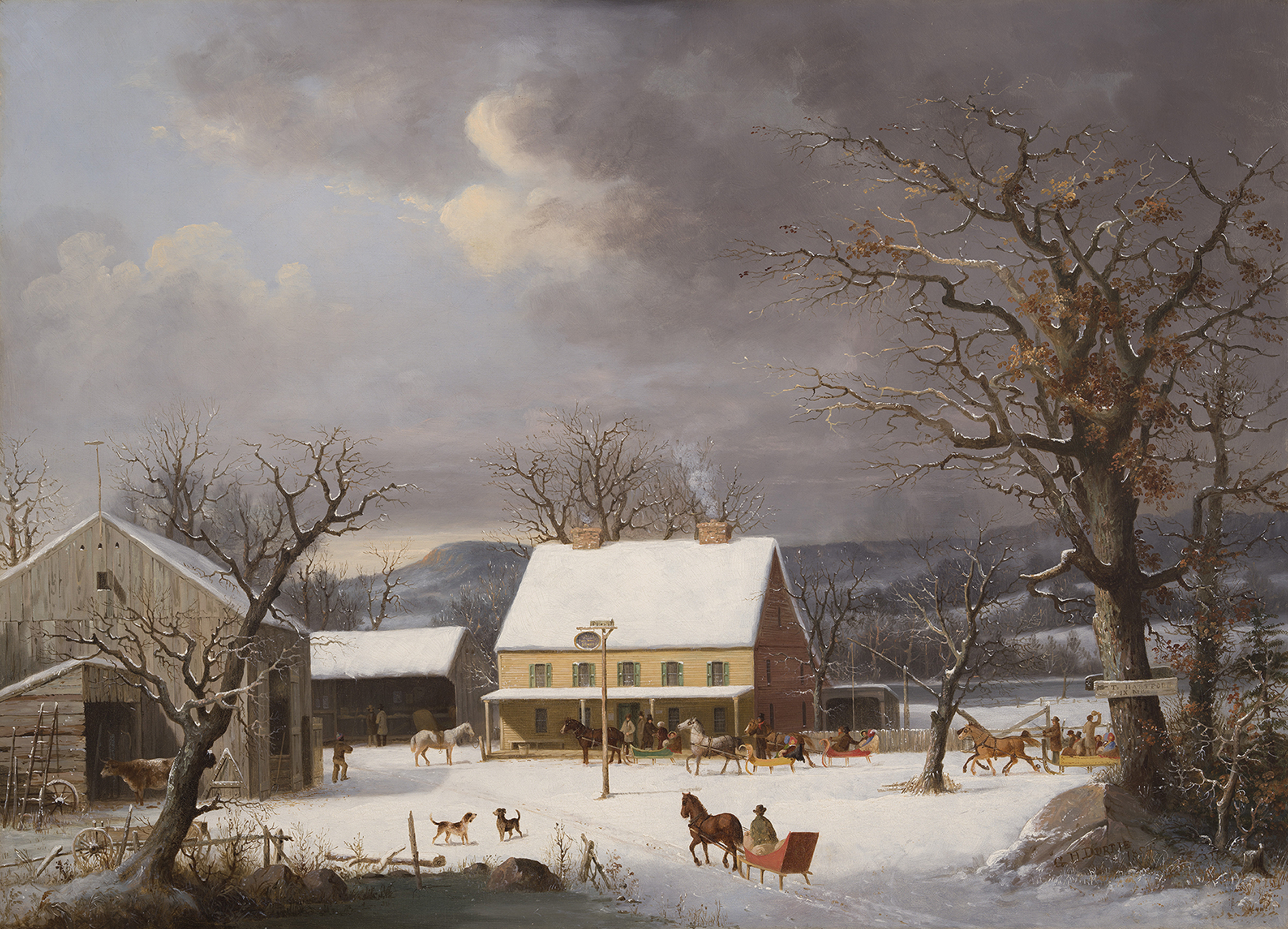
George Henry Durrie (1820-1863)
To Hartford—IX Miles, 1854
Oil on canvas
26 1/4 x 36 in.
Art Bridges. Photography by Edward C. Robison III
To Hartford–IX Miles depicts a wintertime scene in rural Connecticut. The path in the foreground leads the viewer’s eye to a bustling inn, and the colorful sleds, prancing horses, and smoking chimney add a sense of mirthful warmth to the otherwise frigid scenery. Durrie was born in New Haven, Connecticut, and spent his life painting portraits and landscapes in the areas around his hometown. During the 1850s, the artist’s favorite subject was winter scenes like this one, which illustrate the liveliness of everyday country life.
To Hartford–IX Miles is one of Durrie’s most accomplished works, combining charming storytelling with a refined sense of composition. His attention to detail delighted viewers, and the relatable narratives of rustic scenes provided a sense of nostalgia for Americans who were moving from rural to urban areas.

Horace Pippin (1888-1946)
Holy Mountain, I, 1944
Art Bridges
Holy Mountain, I was inspired by the prophecy of a “Peaceable Kingdom” in the biblical book of Isaiah, which describes a paradise where all creatures will live in harmony. Growing up in the African Methodist Episcopal Church, Pippin had early exposure to illustrations from the Bible and hymnals, but unlike the Bible’s description, this painting exhibits moments of secular strife. While the foreground depicts predators and prey laying together in accordance to scripture, the background reveals threatening soldiers prowling the forest next to a graveyard. Holy Mountain, I shares the inscribed date of June 6th, 1944 with D-Day, reinforcing ideas of war and peace. This dynamic had personal significance. Pippin served in World War I, and the figure at center is likely a self-portrait. “If a man knows nothing but hard times he will paint them,” the artist said. “For he must be true to himself, but even that man may have a dream, an ideal—and Holy Mountain is my answer to such dreaming.”
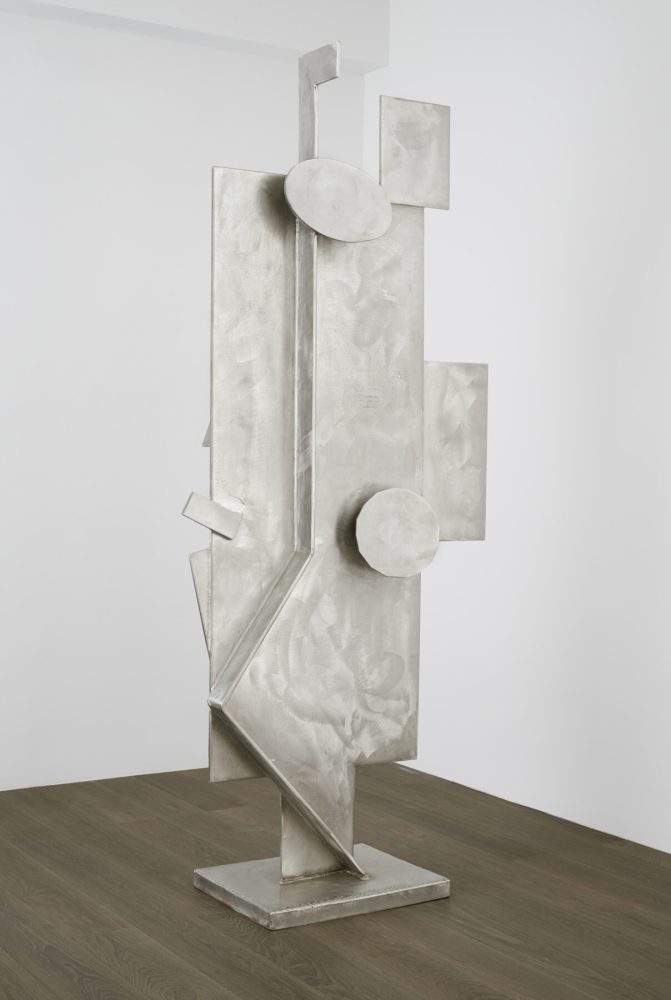
David Smith (1906-1965)
March Sentinel (1961)
Stainless steel
102 × 43 1/2 × 19 3/4 in., 930 lb. (259.1 × 110.5 × 50.2 cm, 421.8 kg)
AB.2018.19
The steel surface and geometric contours of March Sentinel may initially create the impression that it is an absolutely abstract composition. Upon engaging with the sculpture, however, its representational qualities begin to clarify. The work’s verticality cooperates with its distribution of shapes to confirm what the title suggests: Smith has evoked the form of a military guard. The artist’s history as a welder of tanks and trains during World War II informed his sculptures, and he adapted harsh, military materials to human forms. The title implies soldiers marching, and at the same time, documents the date of the sculpture’s creation in the month of March. By using a burnishing technique that produces abraded marks on the work’s surface, Smiths recalls the brushwork of Abstract Expressionism.